Most people would wish that President Obama succeeds in striking a deal with Iran that will see it shut down its nuclear centres, halt uranium enrichment and give up permanently the goal of obtaining a nuclear weapon. Iran however has shown next to no signs that it will forgo its nuclear weapons program. What most of us don't know is how ordinary Iranian citizens opposed to the mullahs' regime would feel about a "bad deal" that would see Tehran cheat its way to the bomb as it stalls world powers.

Amineh Qaraee, 34, and her brother Ehsan, 28, who fled the mullahs' persecution to Norway four years ago, have a striking story. As children, they witnessed their parents’ arrest and imprisonment for supporting the People’s Mojahedin Organization (PMOI/MEK), the main moderate Muslim group opposed to Khomeini’s theocratic rule.
"When I was just one-year-old my father got arrested, and two months later my mother got arrested with me and they took us to prison. There I had to live between people who got arrested and tortured just because they wanted freedom", Amineh recounts in a moving video testimonial.
"I spent some months in prison until they let my mother deliver me to my grandparents. My mother was in prison for more than two years and my father for four years."
Soon after his release, Amineh’s father, a teacher by profession, was again arrested for his political opinions.
"Finally they informed us that they had killed my father and 30,000 other political activists even though all of them were sentenced to some years in prison, not execution”, she adds before breaking down into tears. This has prompted them to join the cause of supporting human rights and democratic change in Iran through different activities, including promoting petitions and other initiatives through facebook, twitter and youtube.
The Qaraees are not the only families of victims of the mullahs left to deal with the torment of losing their loved ones. The Tehran regime has executed more than 120,000 political prisoners, mostly MEK supporters, in the past 36 years. Their families who live in daily agony number in the millions. An overwhelming majority of Iranians have been harmed or affected in some form by the regime in its 36-year rule.
A robust, strong deal with strong inspection regime will manifest Ayatollahs’ weakness and strategic deadlock and embolden Iranian people for their rights. Yet, like many other Iranians opposed to the regime, Amineh and Ehsan are nervous that a “bad nuclear deal” allowing Tehran to go nuclear while duping the West would strengthen the regime. Such an outcome will lead to the situation where the Revolutionary Guards would feel strengthened and would suppress any dissent with even greater brutality. The world would then become silent in the face of all the crimes of this regime.
As the 30 June deadline for a nuclear deal between Tehran and the P5+1 world powers draws closer, most of Iran’s neighbours are also wary that Tehran would make a false pledge to forgo its uranium enrichment for weaponization in return for having international sanctions lifted, and all the while secretly building its nuclear weapon. Rightly so.
Former Iranian President Ali Akbar Hashemi Rafsanjani is on record as having said in the early 1990s that if Iran succeeded in obtaining a nuclear bomb, no one would be able to stop it from exporting its Islamic revolution.
Iran’s Supreme Leader Ali Khamenei has made no secret of Tehran’s military, financial and logistical support to keep Syrian dictator Bashar al-Assad in power. Photographs of Iran’s senior Revolutionary Guards Qods Force commanders are intentionally published in state media to show the regime’s military presence in Iraq.
Iran’s Arab neighbours and Israel fear that a nuclear bomb would make Iran the region’s undisputed hegemon with a keen desire to expand its borders.
The concern over Tehran’s abysmal human rights record is shared by many of our allies in Europe.
Last week, in a statement signed by over 220 members of the European Parliament, representing all political groups in the Parliament from the European Union’s all 28 member states, European lawmakers slammed Iran’s gross human rights violations and called on Iranian regime to “end the executions, free political prisoners, stop the repression of women and respect the rights and freedoms of the Iranian people.” The statement infuriated Tehran.
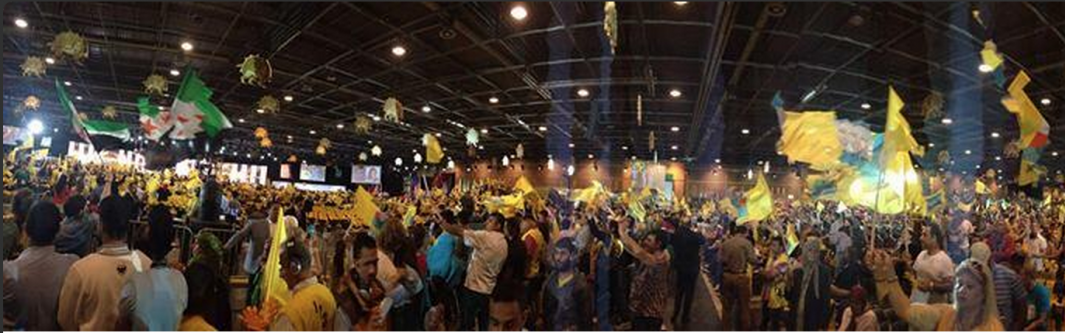
Amineh and Ehsan plan to join Iranian expatriates in a grand rally 13 June in support of democratic change by the main opposition coalition National Council of Resistance of Iran (NCRI). The council, led by its charismatic President-elect Maryam Rajavi, has a 10-point platform calling for a democratic pluralistic republic based on universal suffrage, freedom of expression, abolition of torture and death penalty, separation of religion and state, a non-nuclear Iran, an independent judicial system, rights for minorities, peaceful coexistence in the region, gender equality and commitment to Universal Declaration of Human Rights. Some 100,000 people took part in a similar rally last year.
The rally will also draw several hundred international lawmakers, personalities and former officials of both Democrat and Republican administrations, who support Maryam Rajavi’s platform. There will be a strong show from parliamentarians of Arab countries who ardently support a change of regime in Tehran that would transform their Shiite neighbour into a peaceful partner. Parliamentary delegations from across Europe will also be present to support the call for democracy.
According to Amineh, "The huge gathering in Paris on June 13 introduces the alternative to the rule of mullahs in Iran.”
“We can learn from the history that our resistance and its members, who have made so many sacrifices to bring about freedom and democracy to Iran, and we won’t stop until we achieve these goals”, Ehsan says. This is a struggle that the world community should support, or else the whole world will be held to ransom by the criminal mullahs with nuclear weapons.
It is only prudent for the West to listen to Iranian dissidents as well in formulating a sound policy on Iran. As a human rights researcher I shall be attending the rally which will be broadcast live.
Tanter, a professor emeritus, University of Michigan, is president of the American Committee on Human Rights.